> ## Documentation Index
> Fetch the complete documentation index at: https://innateinc-theo-docs-skills-authoring-api.mintlify.site/llms.txt
> Use this file to discover all available pages before exploring further.
# Spatial Memory
Requires **OS 0.7.0** or newer.
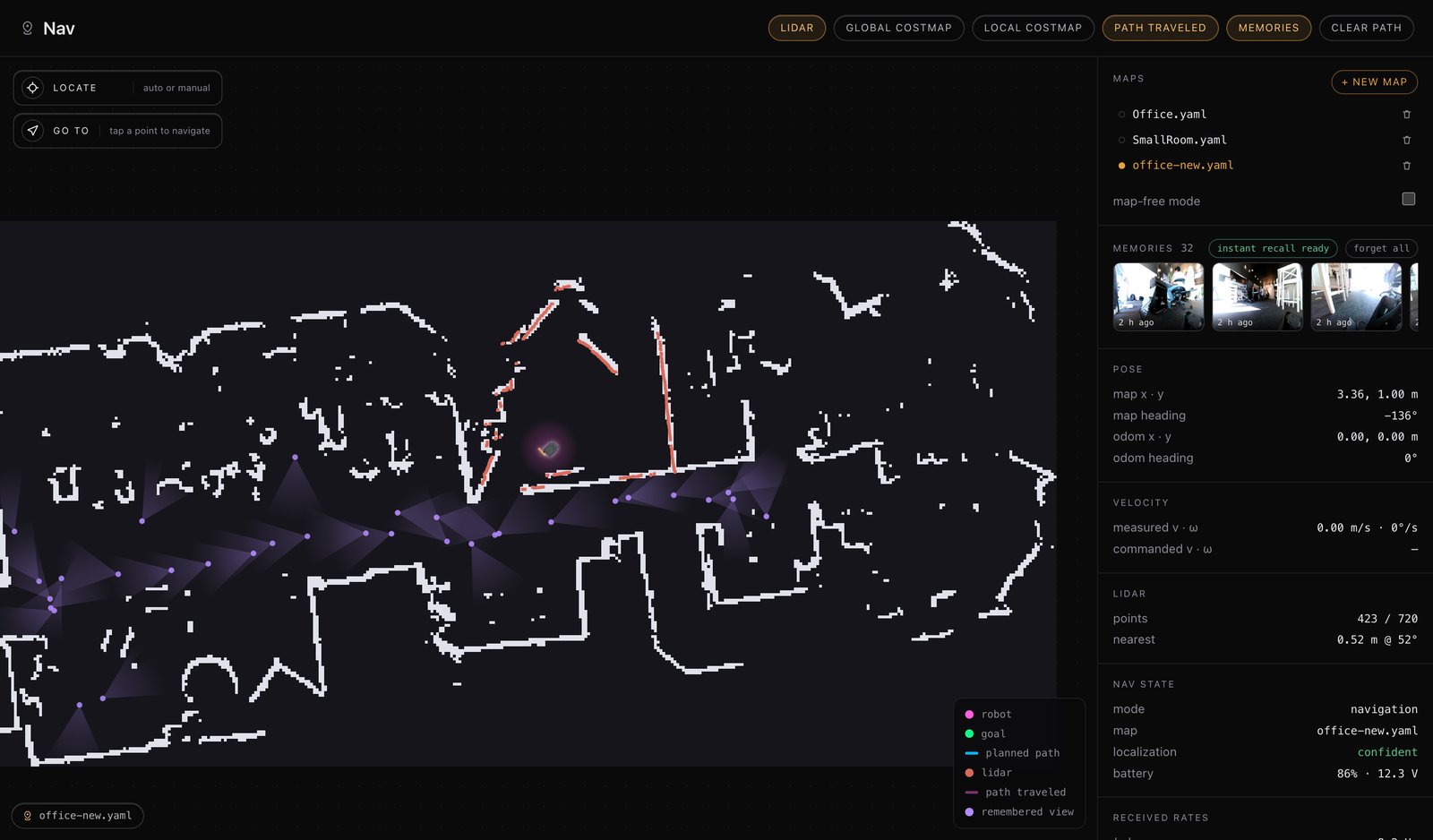
As the robot drives around, it keeps the views worth keeping — each one tied to a spot on the map and to when it was seen. That's its **spatial memory**, and your skills can search it.
 You ask in plain language ("the kitchen", "a banana", "where you saw my airpods"), a vision model reviews everything remembered on this map, and you get back the best match — with an image, map coordinates, and a timestamp.
## Declaring it
Like any other interface, one annotation:
```innatepy theme={"languages":{"custom":["/languages/python-typed.json"]}}
from innate import Skill, SpatialMemory
class FindIt(Skill):
memory: SpatialMemory
```
## Searching
A search takes a while — a model is reading through a lot of pictures. So `begin()` starts it and hands you back a **reader**, which you wait on with `self.wait_for()`:
```innatepy theme={"languages":{"custom":["/languages/python-typed.json"]}}
def execute(self, query: str):
recall = self.memory.begin(query)
verdict = self.wait_for(recall, timeout=150.0)
if verdict is None:
self.fail("memory search timed out")
return verdict.message
```
Waiting through `self.wait_for()` is what keeps **Stop** responsive — press it mid-search and the skill unwinds like any other. Give it a generous timeout; a well-travelled map can take a couple of minutes.
## What comes back
A `RecallVerdict`:
| Field | What it holds |
| ----------------- | -------------------------------------------------------------------------------- |
| `found` | Whether anything matched. |
| `message` | The answer, written for the agent to read out. |
| `image` | JPEG bytes of the remembered view, or `None`. |
| `x`, `y`, `theta` | Where the robot was standing when it saw it — feed these straight to navigation. |
| `seen_stamp` | When it was seen. |
| `explanation` | Why the model picked this view (or why nothing matched). |
| `error` | Non-empty if the *search itself* broke. |
**`found=False` is not an error.** It means the search worked and the answer is "nowhere" — worth saying out loud. Check `error` separately:
```innatepy theme={"languages":{"custom":["/languages/python-typed.json"]}}
if verdict.error:
self.fail(verdict.message) # the search broke
if not verdict.found:
return "I don't remember seeing that." # the search worked; nothing there
```
## Driving to what you found
```innatepy theme={"languages":{"custom":["/languages/python-typed.json"]}}
from innate import Skill, SpatialMemory
from innate_skills.navigate_to_position import NavigateToPosition
class GoToRemembered(Skill):
memory: SpatialMemory
navigate: NavigateToPosition
def guidelines(self) -> str:
return "Find a place or thing the robot has seen before, and drive there."
def execute(self, query: str):
verdict = self.wait_for(self.memory.begin(query), timeout=150.0)
if verdict is None or verdict.error:
self.fail("memory search failed")
if not verdict.found:
return f"I don't remember seeing {query}."
self.say(f"I remember. {verdict.message}")
self.navigate(x=verdict.x, y=verdict.y, local_frame=False)
return f"Went to where I last saw {query}"
```
Remembered coordinates are in the **map** frame, not relative to where the robot stands now — that's what `local_frame=False` says.
`verdict.theta` is in **radians**, but `navigate_to_position` takes `theta_degrees`. Convert with `math.degrees()` if you want the robot to face the way it was facing — or leave it out, as above.
## The shipped skill
`search_memory` already does the basic version, in full:
```innatepy theme={"languages":{"custom":["/languages/python-typed.json"]}}
from innate import Skill, SkillOutput, SpatialMemory
class SearchMemory(Skill):
"""Search the robot's long-term memory of places it has seen on this map. ..."""
memory: SpatialMemory
def execute(self, query: str):
recall = self.memory.begin(query)
verdict = self.wait_for(recall, timeout=150.0)
if verdict is None:
self.fail("memory search timed out")
if verdict.error:
self.fail(verdict.message)
return SkillOutput(verdict.message, image=verdict.image)
```
`image=` is the useful bit: it hands the remembered photo to the agent along with the words, so it can *look* at what was found rather than take the sentence on faith.
(It writes its guidelines as a class docstring — [the shorthand](/software/skills/code-defined-skills#the-skill-class) shipped skills use.)
Add it to an agent and the robot will search before claiming it hasn't seen something:
```innatepy theme={"languages":{"custom":["/languages/python-typed.json"]}}
from innate_skills.search_memory import SearchMemory
def get_skills(self) -> list[SkillRef]:
return [NavigateToPosition, SearchMemory]
```
## Where the memory lives
On the robot, one set per map — remembering is automatic while it drives. Browse or clear them from the web app's **Nav** page, above.
You ask in plain language ("the kitchen", "a banana", "where you saw my airpods"), a vision model reviews everything remembered on this map, and you get back the best match — with an image, map coordinates, and a timestamp.
## Declaring it
Like any other interface, one annotation:
```innatepy theme={"languages":{"custom":["/languages/python-typed.json"]}}
from innate import Skill, SpatialMemory
class FindIt(Skill):
memory: SpatialMemory
```
## Searching
A search takes a while — a model is reading through a lot of pictures. So `begin()` starts it and hands you back a **reader**, which you wait on with `self.wait_for()`:
```innatepy theme={"languages":{"custom":["/languages/python-typed.json"]}}
def execute(self, query: str):
recall = self.memory.begin(query)
verdict = self.wait_for(recall, timeout=150.0)
if verdict is None:
self.fail("memory search timed out")
return verdict.message
```
Waiting through `self.wait_for()` is what keeps **Stop** responsive — press it mid-search and the skill unwinds like any other. Give it a generous timeout; a well-travelled map can take a couple of minutes.
## What comes back
A `RecallVerdict`:
| Field | What it holds |
| ----------------- | -------------------------------------------------------------------------------- |
| `found` | Whether anything matched. |
| `message` | The answer, written for the agent to read out. |
| `image` | JPEG bytes of the remembered view, or `None`. |
| `x`, `y`, `theta` | Where the robot was standing when it saw it — feed these straight to navigation. |
| `seen_stamp` | When it was seen. |
| `explanation` | Why the model picked this view (or why nothing matched). |
| `error` | Non-empty if the *search itself* broke. |
**`found=False` is not an error.** It means the search worked and the answer is "nowhere" — worth saying out loud. Check `error` separately:
```innatepy theme={"languages":{"custom":["/languages/python-typed.json"]}}
if verdict.error:
self.fail(verdict.message) # the search broke
if not verdict.found:
return "I don't remember seeing that." # the search worked; nothing there
```
## Driving to what you found
```innatepy theme={"languages":{"custom":["/languages/python-typed.json"]}}
from innate import Skill, SpatialMemory
from innate_skills.navigate_to_position import NavigateToPosition
class GoToRemembered(Skill):
memory: SpatialMemory
navigate: NavigateToPosition
def guidelines(self) -> str:
return "Find a place or thing the robot has seen before, and drive there."
def execute(self, query: str):
verdict = self.wait_for(self.memory.begin(query), timeout=150.0)
if verdict is None or verdict.error:
self.fail("memory search failed")
if not verdict.found:
return f"I don't remember seeing {query}."
self.say(f"I remember. {verdict.message}")
self.navigate(x=verdict.x, y=verdict.y, local_frame=False)
return f"Went to where I last saw {query}"
```
Remembered coordinates are in the **map** frame, not relative to where the robot stands now — that's what `local_frame=False` says.
`verdict.theta` is in **radians**, but `navigate_to_position` takes `theta_degrees`. Convert with `math.degrees()` if you want the robot to face the way it was facing — or leave it out, as above.
## The shipped skill
`search_memory` already does the basic version, in full:
```innatepy theme={"languages":{"custom":["/languages/python-typed.json"]}}
from innate import Skill, SkillOutput, SpatialMemory
class SearchMemory(Skill):
"""Search the robot's long-term memory of places it has seen on this map. ..."""
memory: SpatialMemory
def execute(self, query: str):
recall = self.memory.begin(query)
verdict = self.wait_for(recall, timeout=150.0)
if verdict is None:
self.fail("memory search timed out")
if verdict.error:
self.fail(verdict.message)
return SkillOutput(verdict.message, image=verdict.image)
```
`image=` is the useful bit: it hands the remembered photo to the agent along with the words, so it can *look* at what was found rather than take the sentence on faith.
(It writes its guidelines as a class docstring — [the shorthand](/software/skills/code-defined-skills#the-skill-class) shipped skills use.)
Add it to an agent and the robot will search before claiming it hasn't seen something:
```innatepy theme={"languages":{"custom":["/languages/python-typed.json"]}}
from innate_skills.search_memory import SearchMemory
def get_skills(self) -> list[SkillRef]:
return [NavigateToPosition, SearchMemory]
```
## Where the memory lives
On the robot, one set per map — remembering is automatic while it drives. Browse or clear them from the web app's **Nav** page, above.