
Naming: “the Innate agent” is the loop. The “agents” you write (see Agents) are Python files — a prompt, some skills, some inputs — that tell the loop who to be.
Look, think, act
The agent works in turns. One turn at a time, never two at once:1
Look
Take the latest camera frame, plus everything that happened since the last turn — what you said, what a skill reported, what a sensor sent in.
2
Think
Send that to a vision-language model, together with your agent’s prompt and its skills described as callable tools.
3
Act
Do what came back: start a skill, drive somewhere it can see, say something out loud, or nothing at all.
Watching it think
The web app’s Brain page shows the loop as it runs — the exact frames each turn saw, what it decided, and how long it took.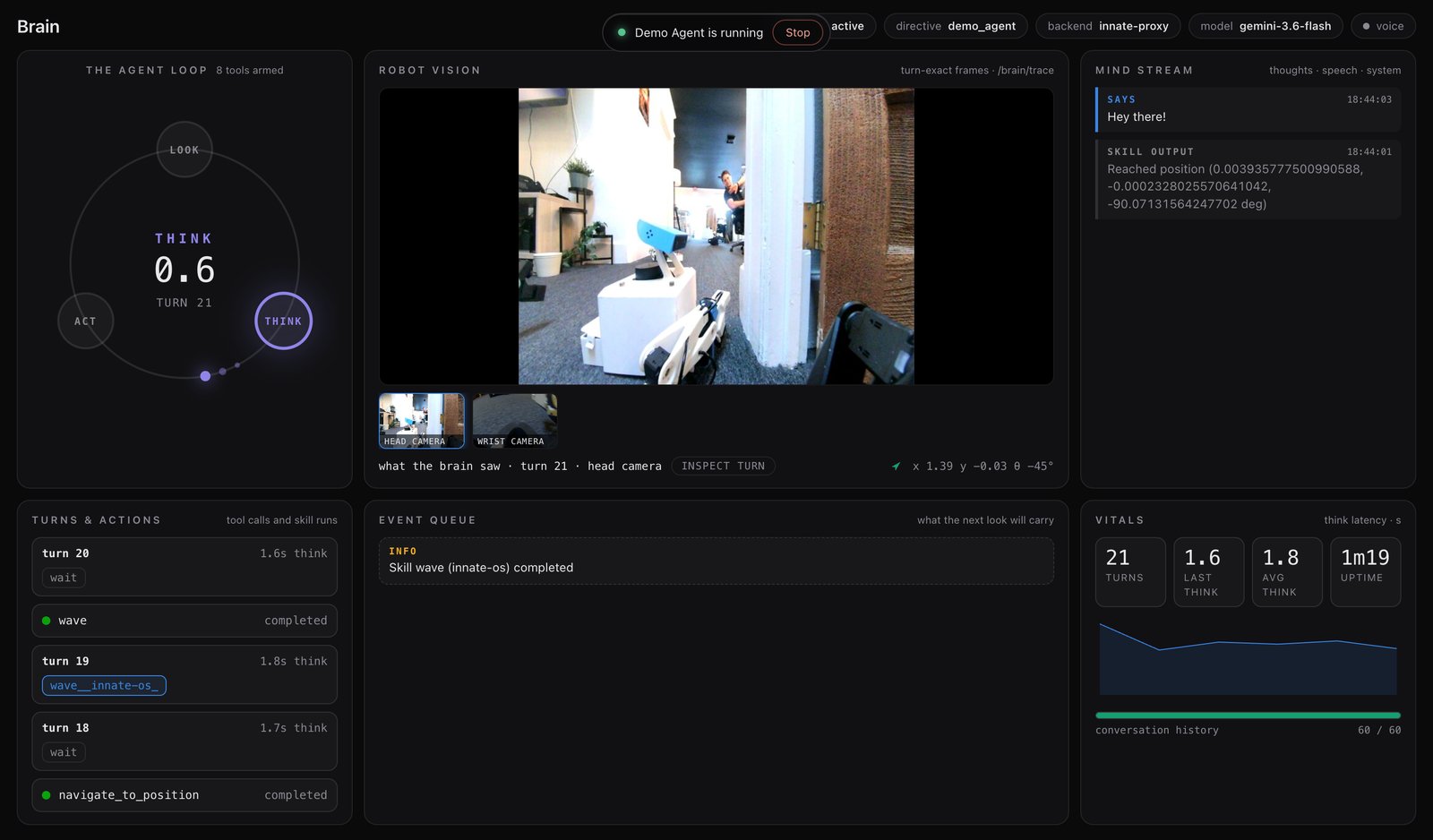
INSPECT TURN opens the full request behind any turn. It’s the fastest way to find out why the robot did something.
Skills are the agent’s tools
Every skill in the active agent becomes a function the model can call. Yourexecute() signature becomes the parameters; your guidelines() (or class docstring) becomes the description. That’s the whole contract — see Code-Defined Skills.
Three tools are always there, whatever your agent lists:
While a skill runs, stopping it is the only action offered. The robot can still talk — it just can’t start a second skill on top of the first.
Which model runs it
The agent runs on Gemini (gemini-3.6-flash by default — the model is a brain_client_node setting in config/settings.yaml). There are three ways to connect it, set in the .env file on the robot:
The hosted brain is free for all users of Innate robots for 300 cumulative hours — and probably more if you ask us on Discord.
Your service key lives in
~/innate-os/.env on the robot; cat ~/innate-os/.env shows it. If you’ve lost it, ask us on Discord or by email.